

Events
-
-
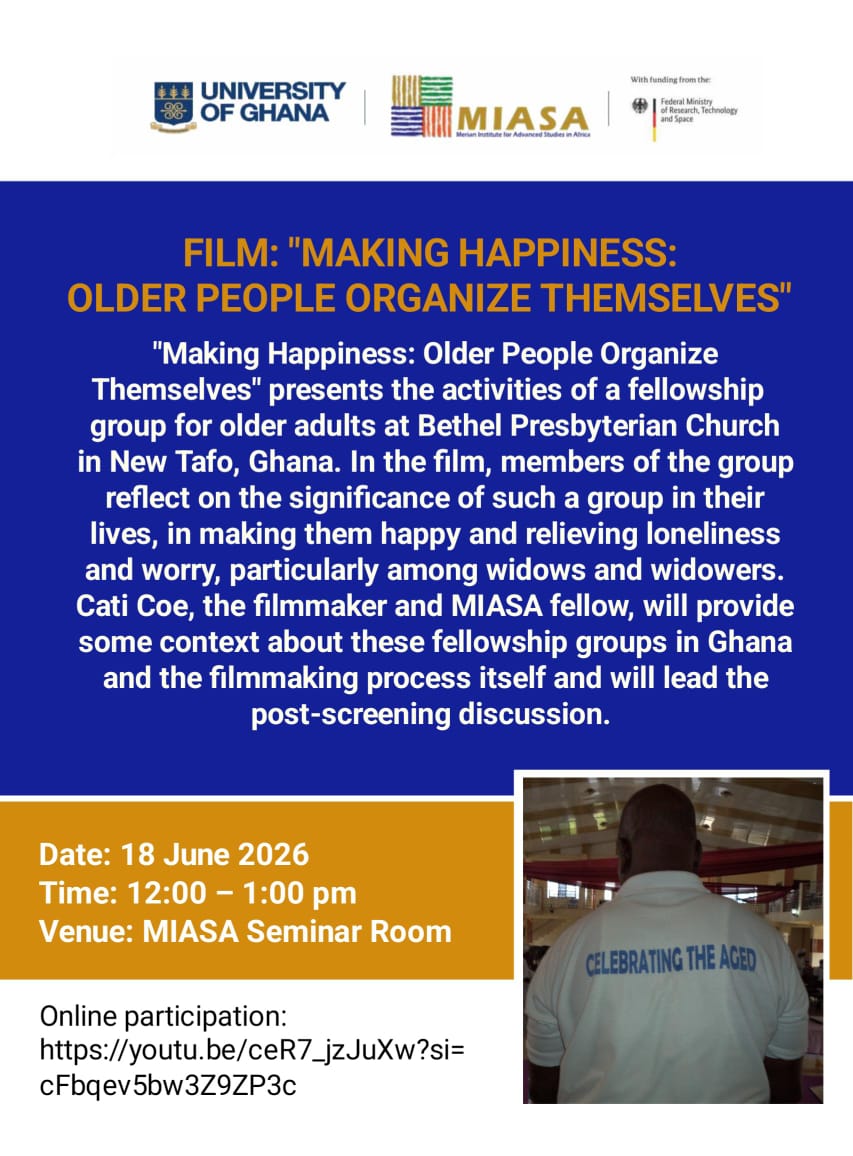
Film: “Making Happiness: Older People Organize Themselves”
FeaturedMIASA Seminar Room"Making Happiness: Older People Organize Themselves" presents the activities of a fellowship group for older adults at Bethel Presbyterian Church in New Tafo, Ghana. In the film, members of the group reflect on the significance of such a group in their lives, in making them happy and relieving loneliness and worry, particularly among widows and ... Read more
-
Dance Performance: Kor yε; Artist in Residence: Natasa Chanta-Martin
Department of Dance Studies, University of GhanaDescription: During her MIASA residency, Natasa explored what happens to Ghanaian dance and music cultures when the musical instruments are not there. How do moving bodies suffice as repositories of knowledge and of embodied music? Is our body enough for the sustainability of our intangible cultural heritage? The answer is explored through the medium of ... Read more
-

Public Lecture: What does “sustainable governance” mean? Situating the debate in an “ecologies of knowledge” framework; Speaker: Susann Baller
MIASA Seminar RoomAbstract: The lecture reflects about MIASA’s main topic of “sustainable governance” by taking a non-normative approach, unwrapping the concept from different disciplinary perspectives. The lecture explores the semantic fields of “sustainable” and “governance” as well as the combination of both, and it asks how the use and non-use of “sustainable governance” as a concept is ... Read more
-
-
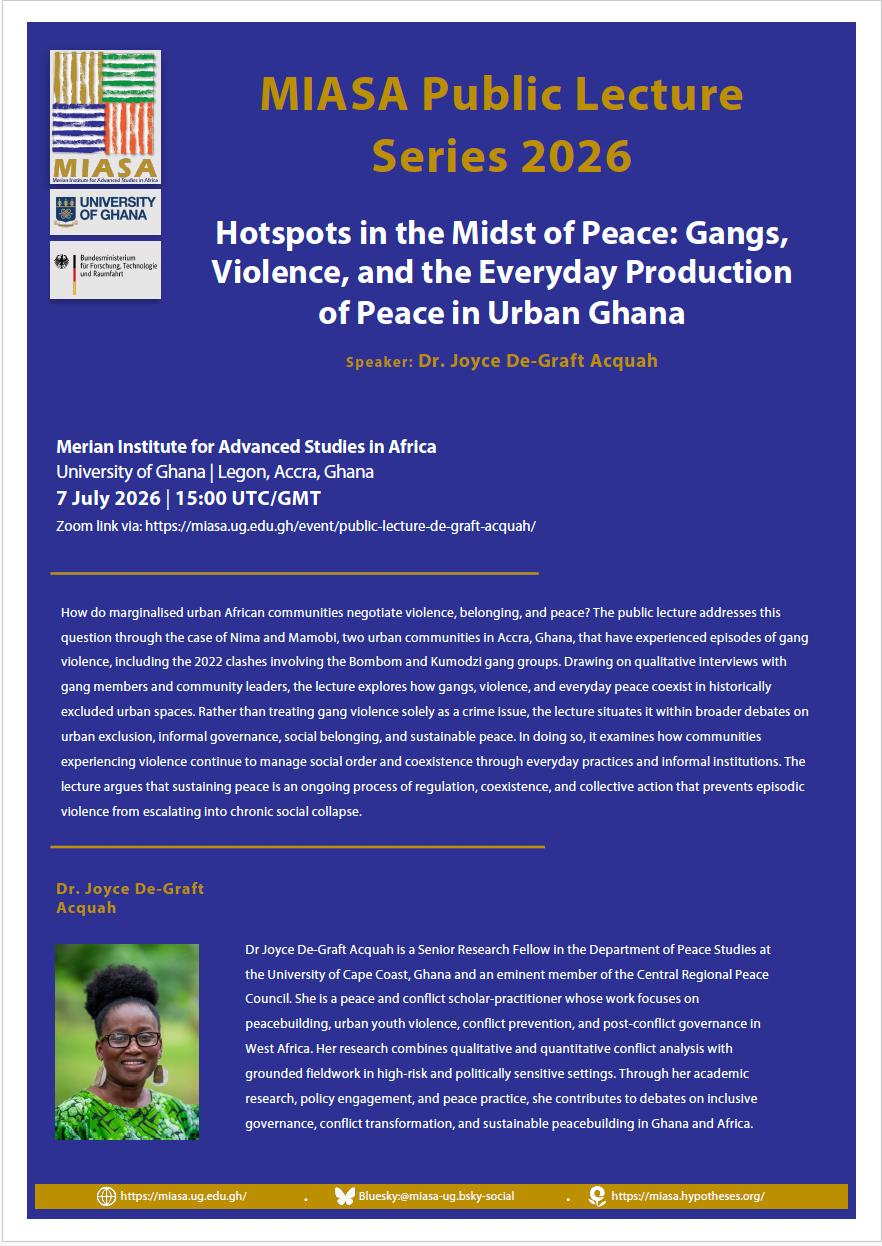
Public Lecture: Hotspots in the Midst of Peace: Gangs, Violence, and the Everyday Production of Peace in Urban Ghana; Speaker: Joyce De-Graft-Acquah
MIASA Seminar RoomAbstract: How do marginalised urban African communities negotiate violence, belonging, and peace? The public lecture addresses this question through the case of Nima and Mamobi, two urban communities in Accra, Ghana, that have experienced episodes of gang violence, including the 2022 clashes involving the Bombom and Kumodzi gang groups. Drawing on qualitative interviews with gang ... Read more
-
Female Academic Careers in Africa Workshop 2026
Yiri Lodge, University of GhanaMerian Institute for Advanced Studies in Africa (MIASA) in cooperation with the German Historical Institute Paris (GHIP), the Centre for Gender Studies and Advocacy (CEGENSA), University of Ghana (UG), and the Centre marc Bloch Berlin (CMB). Sponsored by the Federal Ministry for Education and Research in Germany and with the support of the University of ... Read more
-
Public Roundtable: Beyond Representation: Strengthening Women’s Leadership and Transforming Academic Cultures in African Higher Education
For online participation: https://maxweberstiftung.zoom-x.de/j/62475717218 Women are increasingly getting represented in African higher education, including in academic leadership positions. While this marks important progress, the numbers remain far from being equitable. More importantly, the representations do not automatically translate into impact or influence. The challenge is not only increasing the number of women in leadership, but also ... Read more
-
Public Lecture: Rethinking Mining Governance from the Grassroots Up: Eastern Senegal Facing the Challenges of Extractivism and Security Threats; Speaker: M. Lamine Diallo
MIASA Seminar RoomAbstract: This paper offers a critical analysis of mining resource governance in eastern Senegal, viewed not solely through institutional frameworks but through the practices, forms of resistance, and local arrangements that shape daily life in mining regions—that is, a “bottom-up” approach to governance. This analysis takes place in a border region plagued by security threats ... Read more
-
Post-IMRF 2026 National Stakeholder Forum
Human mobility continues to shape social, economic, political, and cultural realities across the globe. As migration increasingly intersects with issues of development, labour mobility, climate change, regional integration, human rights, and security, the need for collaborative and evidence-based migration governance has become more important than ever. The Global Compact for Safe, Orderly and Regular Migration ... Read more
-
Workshop: Improving Environmental Journalism in Ghana
ISSER Seminar Room, University of Ghana, LegonBackground & Rationale Ghana faces an accelerating convergence of environmental crises — illegal artisanal mining (galamsey), plastic pollution choking urban drainage systems, marine ecosystem degradation, rapid deforestation across forest reserves, and the intensifying impacts of climate change on coastal and savannah communities. Despite the urgency of these environmental challenges, media coverage lacks depth, often leaning toward ... Read more
-
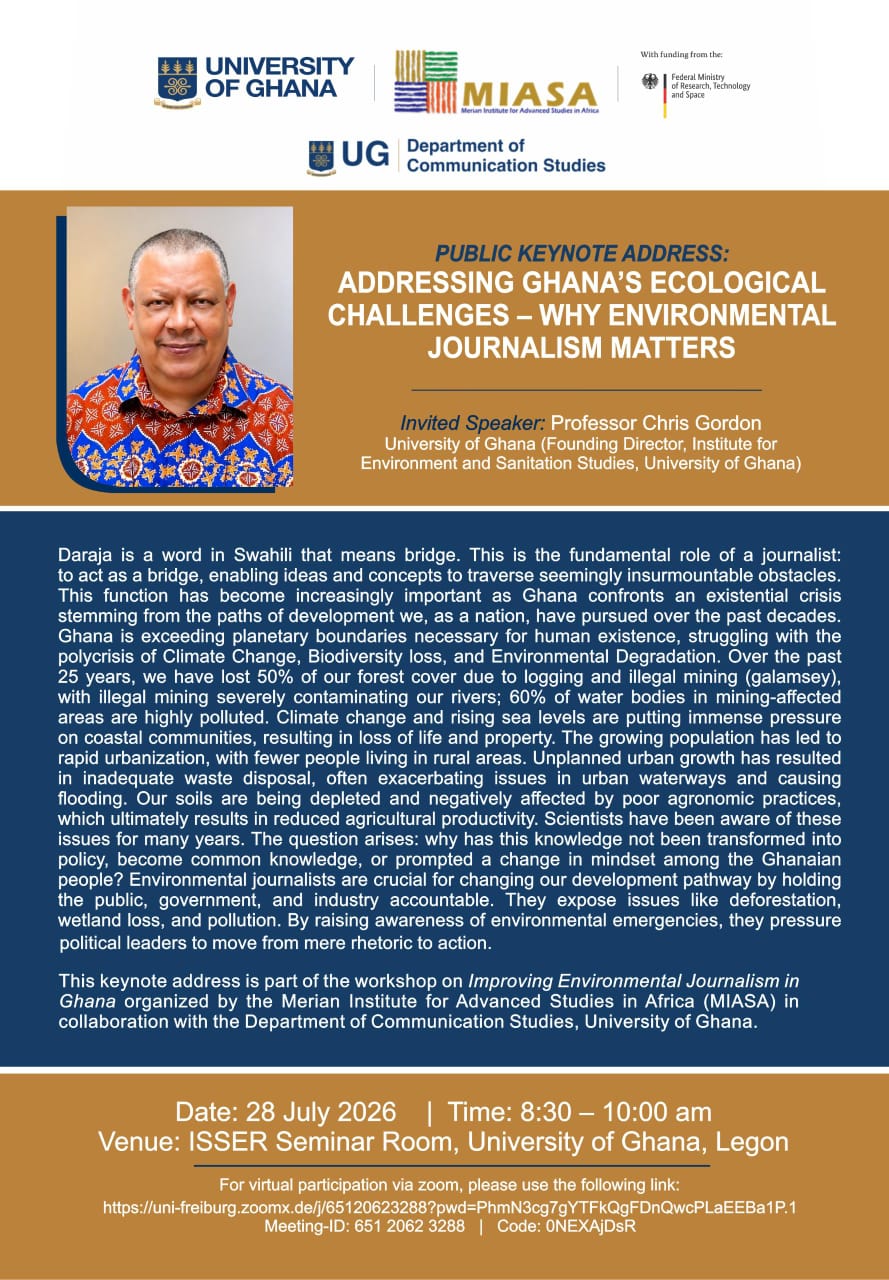
Public Keynote Lecture: Addressing Ghana’s Ecological Challenges – Why environmental journalism matters; Invited Speaker: Professor Chris Gordon, University of Ghana
ISSER Seminar Room, University of Ghana, LegonAbstract: Daraja is a word in Swahili that means bridge. This is the fundamental role of a journalist: to act as a bridge, enabling ideas and concepts to traverse seemingly insurmountable obstacles. This function has become increasingly important as Ghana confronts an existential crisis stemming from the paths of development we, as a nation, have ... Read more
-
-
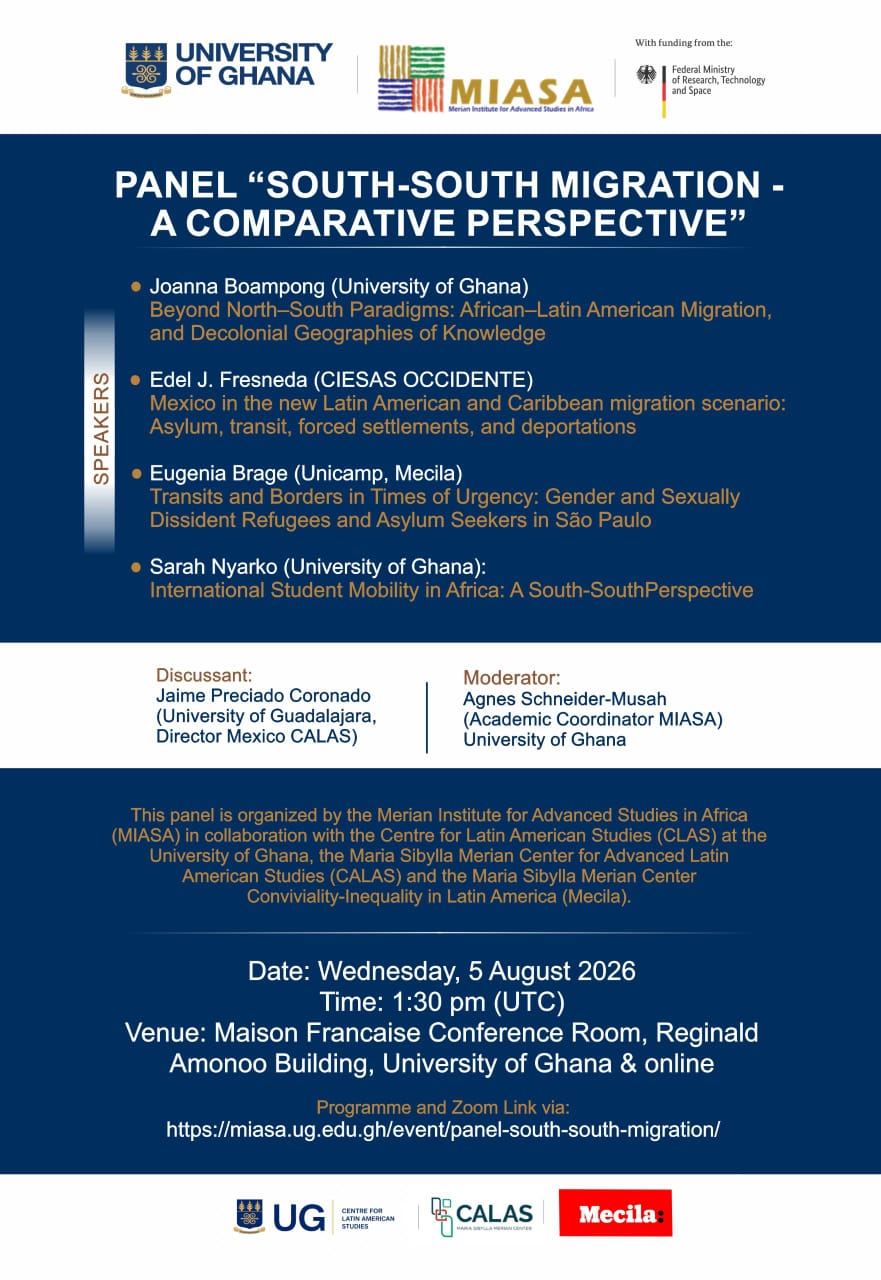
Panel: South-South Migration – A Comparative Perspective
Maison Francaise Conference Room, Reginald Amonoo BuildingPanel Abstract: Policies and Research on migration, displacement and flight are still dominated by Western-centric perspectives and narratives. The majority of movement, though, takes place within the so-called Global South. This panel aims to shine light on the multiple forms of this South-South-migration including dimensions such as international student mobility which has so far been ... Read more
-
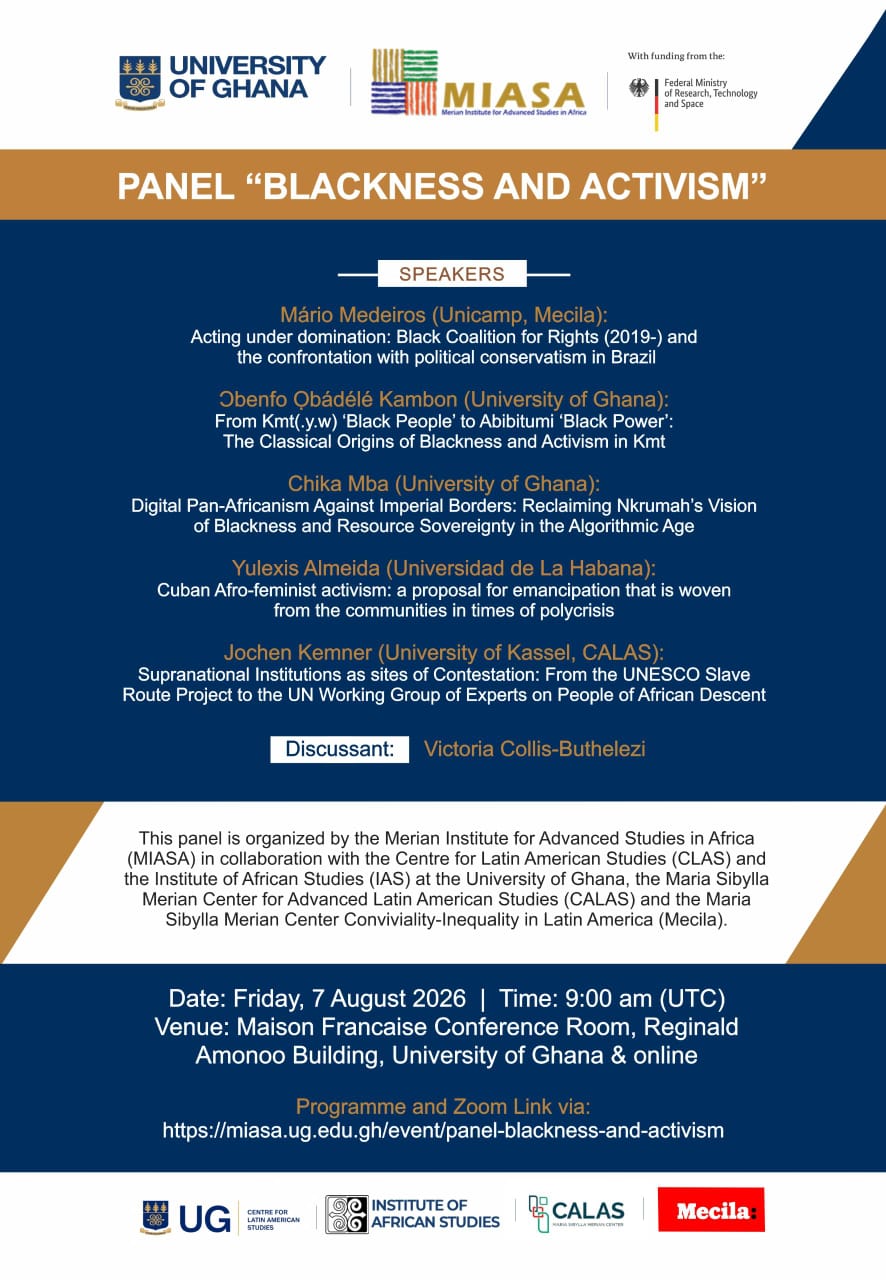
Panel: Blackness and Activism
Maison Francaise Conference Room, Reginald Amonoo BuildingPanel Abstract: This panel focuses on the intellectual agendas and political networks that have shaped Black activism in various parts of the world. By placing West Africa, Brazil, and the Caribbean in a comparative dialogue, this panel explores how "Blackness" functions as both a site of shared local and global experience and a catalyst for ... Read more