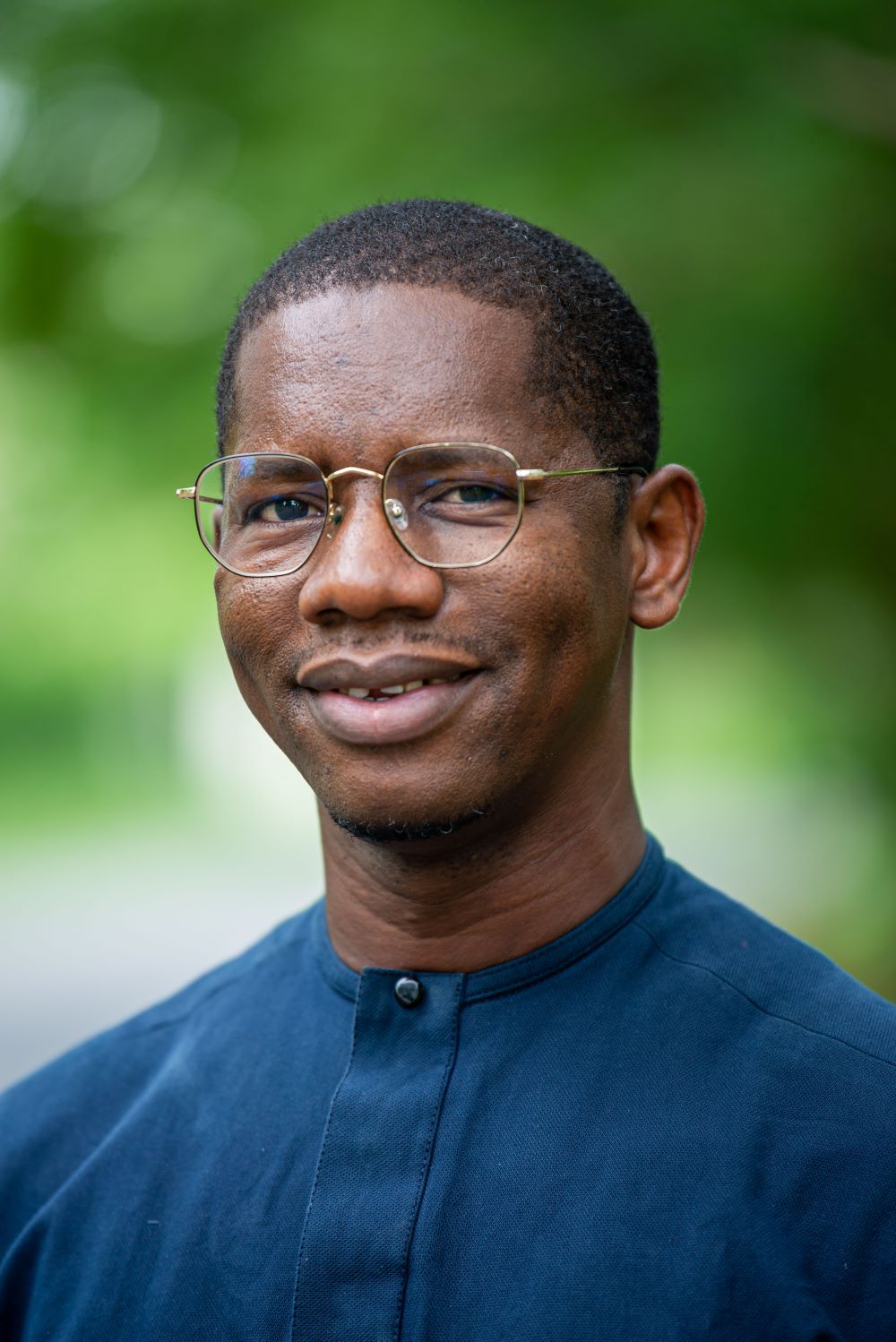

Mouhamadou Lamine DIALLO is an Associate Professor of Geography at Cheikh Anta DIOP University in Dakar (UCAD), specifically within the Department of History and Geography at the Faculty of Sciences and Technologies of Education and Training (FASTEF). In this capacity, he coordinates the Master’s program in History and Geography Education. Prior to joining UCAD in 2021, he played a key role in developing and managing the pedagogical framework for the International Master’s program GAED (Management of Extractive Activities and Development).
From 2017 to 2023, Dr. Diallo served as the national coordinator for Senegal in a sub-regional research program titled “Access to Health, Mineral Resources, and Public Policy in Sub-Saharan Africa,” funded by the Social Sciences and Humanities Research Council of Canada (Insight Grant No. 435-2017-1155). Additionally, in 2021 and 2022, he collaborated with the French consulting firm SOFRECO as the lead for the socio-economic component of a regional study regarding the impact of artisanal gold mining on the Falémé River.
A member of several research laboratories and an associate researcher at UMR 8586 PRODIG, Dr. DIALLO also serves as the President of the Senegalese Association of Geography. He holds a Doctorate in Geography from both Paris 1 Panthéon-Sorbonne University and Gaston Berger University of Saint-Louis, Senegal. His research focuses on mineral resource governance and territorial development in Senegal and across Africa through the lens of political geography. He has authored numerous scientific articles and a book in this field. ORCID: https://orcid.org/0009-0009-4056-4349
Projet de recherche dans le cadre du fellowship à MIASA : Governance of Mineral Resources, Security Challenges, and Sustainable Peace in the Peripheral Regions of Senegal (Kedougou, Tambacounda)
This project examines natural resource governance in the era of extractivism within the context of Eastern Senegal, specifically the Kédougou region. Having long remained on the socio-economic and territorial margins, South-Eastern Senegal has, over the past decade, moved to the forefront of political concerns. This shift is driven, on one hand, by the intensification of both industrial and artisanal gold mining activities and, on the other, by rising frustration among local populations who feel excluded from the resulting economic benefits.
Social tensions are further exacerbated by the fact that the region—already vulnerable to regional political instability—has become a hub for diverse migratory flows. While Mali faces extremist threats and Guinea-Conakry undergoes a period of instability following a military coup, artisanal mining sites in Senegal host a workforce that is predominantly of foreign origin (Mali, Guinea, Burkina Faso). Consequently, the disenchantment of local communities, coupled with the porosity of borders, constitutes a significant security vulnerability for the region.
This situation raises critical questions: To what extent does this dynamic compromise sustainable peace in South-Eastern Senegal? What are the limitations of government initiatives in the face of these security challenges? The objective of this research project is to utilize qualitative field data to analyze the mechanisms of mineral resource governance and their shortcomings within a cross-border and extractive context.
Selected publications
- Mouhamadou Lamine DIALLO, Elhadji Serigne TOP, 2025. Ruée des mineurs d’origine chinoise vers l’or vers les frontières du Sénégal et du Mali : instabilité politique et gouvernance du secteur extractif, AHOHO, Revue de Géographie du LARDYMES, Université de Lomé, pp. 94-102 : ISSN-P : 1993-3134, ISSN-L : 3007-4185, SJIF 2025: 5.123
- Elhadji Serigne TOP, Mouhamadou Lamine DIALLO, (Janvier 2025). La Falémé, entre agriculteurs et miniers : analyse des mobilisations sociales dans un espace aurifère transfrontalier (Sénégal, Mali), Revue AKIRI, Sciences Humaines, Sociales, Lettres, Lagues et Civilisations. pp : 283-301, E-ISSN 2958-2814 (Online ou en Ligne), I-ISSN 3006-306X (Print ou imprimé),
- Bakary DOUCOURE, Mouhamadou Lamine DIALLO (Septembre 2024) : Le Sénégal de l’or et l’or du Sénégal entre 2000 et maintenant : indicateurs et facteurs d’évolution, GEOREVIEW, DOI: https://doi.org/10.4316/GEOREVIEW.2024.01.10 ,Vol. 34.1 / 2024, 156-169,
- El Hadji Serigne Top, Mouhamadou Lamine Diallo, Gilles Arnaud-Fassetta, Géraud Magrin (2024). Gold mining, discourses, and threats: What is really damaging the fluvial hydrosystem of the Faleme River? Journal of political ecology, pp868-887,
- Elhadji Serigne TOP, Mouhamadou Lamine DIALLO, (2025). Dynamique récente de l’orpaillage entre le Mali et le Sénégal : les facteurs du regain de l’activité et les relations entre les mines et la rivière Falémé, Revue Internationale de la Recherche Scientifique (Revue-IRS) ISSN: 2958-8413, Vol. 3, No. 4, Août 2025, pp. 4231-4242,
- Amadou Sarr DIOP, Mouhamadou Lamine DIALLO (2024): Les frontières en afrique artificialité, variantes dimensionnelles et systèmes de conflits, Etudes togolaises, Revue togolaise des sciences, Numéro spécial – Décembre 2024 – ISSN 0531–2051, pp.57- 70
- Mouhamadou Lamine DIALLO, 2017. Le Sénégal des mines, les territoires de l’or et du phosphate, ouvrage publié à l’Harmattan, ISBN : 978-2-343-10160-6, 343 p.
- Mouhamadou Lamine DIALLO, 2019. Gouvernance des territoires en zones minières: jeu d’acteurs et relations de pouvoirs dans les communes de Sabodala et de Tomboronkoto (Sénégal), revue de géographie du Lardymes, n°22-13e année, Laboratoire de Recherche sur la Dynamique des Milieux et des Sociétés, Faculté des Sciences de l’Homme et de la Société, Université de Lomé, p. 187-199, ISSN 1993-3134
- Mylène Coderre, Mouhamadou Lamine Diallo, Alfousseyni Diawara et Bonnie Campbel 2019. La Vision minière pour l’Afrique et les transformations des cadres règlementaires miniers : les expériences du Mali et du Sénégal, revue canadienne d’études du développement, https://doi.org/10.1080/02255189.2019.1650333
- Mouhamadou Lamine DIALLo, 2017 : L’industrie du phosphate de Taïba au Sénégal : front minier et tensions locales, VertigO – la revue électronique en sciences de l’environnement, Hors-série 28 | avril 2017 URL : http://vertigo.revues.org/18330 ISSN : 1492-8442 https://doi.org/10.4000/vertigo.18330
- Mouhamadou Lamine Diallo, 2009. Mine d’or et développement durable : Quelques réflexions sur le site de Sabodala (Sénégal oriental), Revue échogéo, http://echogeo.revues.org/11103 https://doi.org/10.4000/echogeo.11103
- Géraud Magrin et Mouhamadou Lamine Diallo, 2016. Activités extractives : nouvelles dynamiques et impacts sur la ruralité, Denis Pesche (dir) Atlas – Une nouvelle ruralité émergente en Afrique (2e édition), 11e planche
- Géraud Magrin et Mouhamadou Lamine Diallo, 2015. L’enfer est pavé de bonnes intentions, la régulation environnementale et sociale de l’or au Sénégal oriental, REDON Marie et al. (dir), Ressources mondialisées, essai de géographie politique, publication de la Sorbonne, pp. 304-322. ISBN : 978-2-85944-908-7
You are currently viewing a placeholder content from X. To access the actual content, click the button below. Please note that doing so will share data with third-party providers.
More Information