
Lectures
The MIASA Public Lecture Series features MIASA fellows in residence. It is primarily directed to researchers and students but is also open to the wider public.
The Anton Wilhelm Amo Lecture is organized annually by MIASA at the University of Ghana in collaboration with the Institute of African Studies and the Department of Philosophy and Classics at the University of Ghana. It is named after the 18th century philosopher from present-day Ghana who taught at the universities of Halle and Jena. The lecture series promotes MIASA’s overarching commitment of making African thinking increasingly relevant in global academia, and it addresses questions of how the humanities and social sciences can contribute to the decolonisation of knowledge production and epistemic justice.
Events
-
-
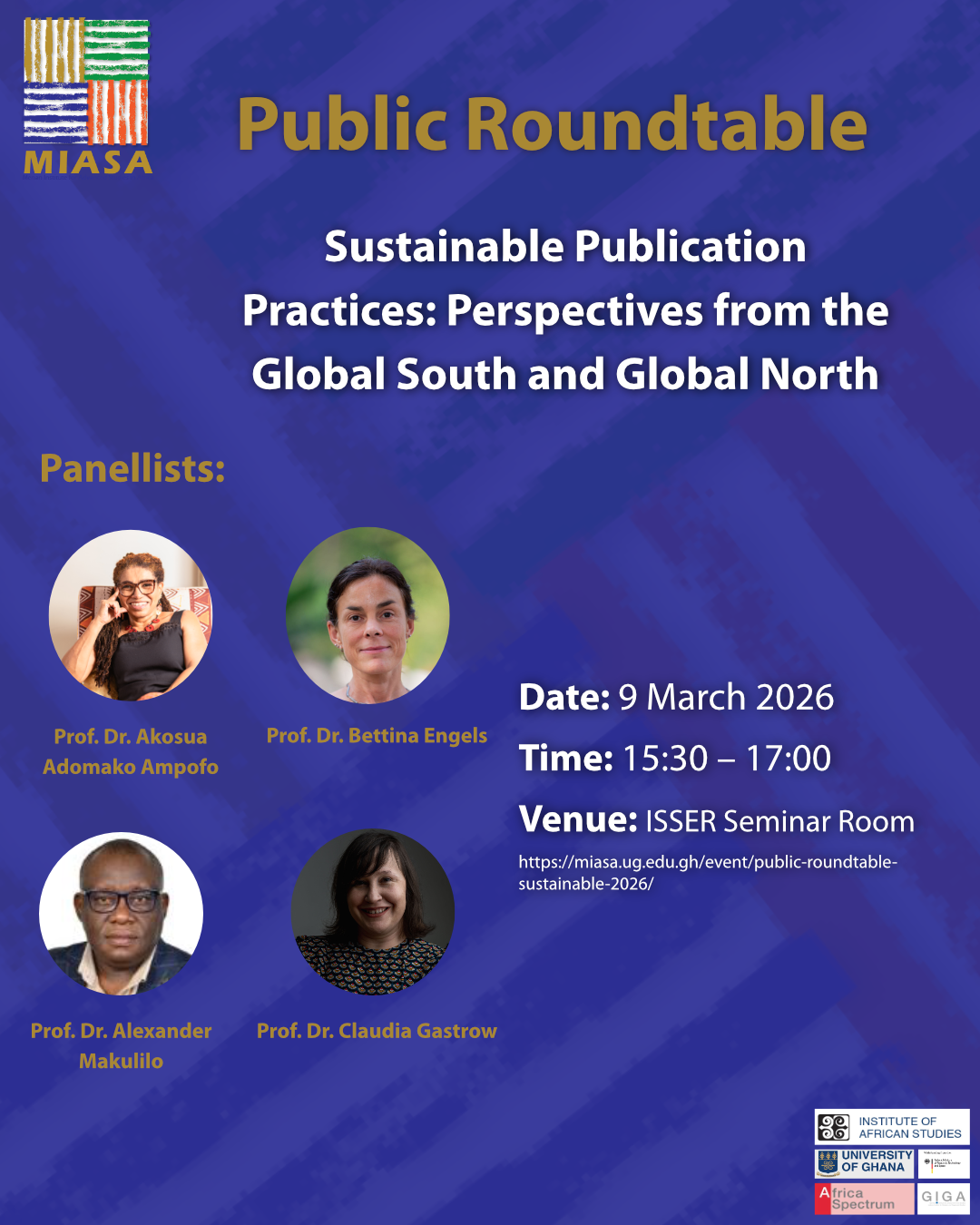
Public Roundtable: Sustainable Publication Practices: Perspectives from the Global South and Global North
ISSER Seminar Room, University of Ghana, LegonAcademic publishing practices play a gatekeeping role in determining what counts as “academic knowledge,” shaping both what scholars read and what they are able to publish. They operate within a global context in which epistemologies are shaped by asymmetrical power relations, material conditions, and patterns of (neo)coloniality. For example, research on citation patterns shows that ... Read more
-
Public Lecture: “Plotting Sovereignty, Staging Liberation”; Speaker: Kenny Cupers
Abstract: What can the limits of postcolonial land restitution tell us about our planetary crisis today? Scholarship in architectural, urban, and environmental history has become increasingly planetary in scope, yet it has rarely engaged issues of land and sovereignty that postcolonial and African historians have long studied. This talk develops earthmaking as a framework — attending to ... Read more
-
Public Lecture: “Critique of Political Decolonization”; Speaker: Bernard Forjwuor
MIASA Seminar RoomThis lecture is open to the public. For online participation please use the following link: https://uni-freiburg.zoom-x.de/j/69315124020?pwd=IQcg6SlG6iLQnj2Wl6PJf8Bv5PatUQ.1 Meeting-ID: 693 1512 4020 Code: L4dvt0qVb
-
-
Policy Dialogue: The relationship between migration research and policy practice in Africa
Chair: Dr. Stefan Rother, Director (Germany) of MIASA Speakers: Prof. Leander Kandilige, Centre for Migration Studies, University of Ghana Abena Owusua Amponsah-Bio, Implementation Manager (DV)/ Programme Component Manager Programme Shaping Development-oriented Migration MEG, GIZ Office Accra Prof. Jesper Bjarnesen, Senior Researcher, Nordic Africa Institute, Uppsala, Sweden Kachi Madubuko IOM Senior Policy Officer, Trade and Mobility ... Read more
-
“Salafi Revival, Contested Identities and Conflicts in Postcolonial Ghana (1950s – 2000s)”; Speaker: Professor Yunus Dumbe
MIASA Seminar RoomAbstract: This project which aims to produce a monograph analyses the dynamic growth of Salafism and its revival from the early postcolonial Ghana (1950s-2000). I seek among others to analyse the changing trajectories of Salafi revival from proselytization to intra-Salafi and Muslim conflicts and the implications of its transformation as a national movement in Ghana. ... Read more
-
-
Public Lecture: “Desert Scenes: Transformative Relationality in Genocidal Extractive Zones”; Speaker: Henriette Gunkel
MIASA Seminar RoomAbstract: During a site-specific workshop week in and around Lüderitz, Namibia in 2023, a group of artists, academics and activists from primarily Namibia and Germany followed the question of “How may something — in this case, the white settler colonial violence and the genocide, — be memorialized while its impact continues to unfold?”. Through collaborative, transdisciplinary practices, ... Read more
-
-
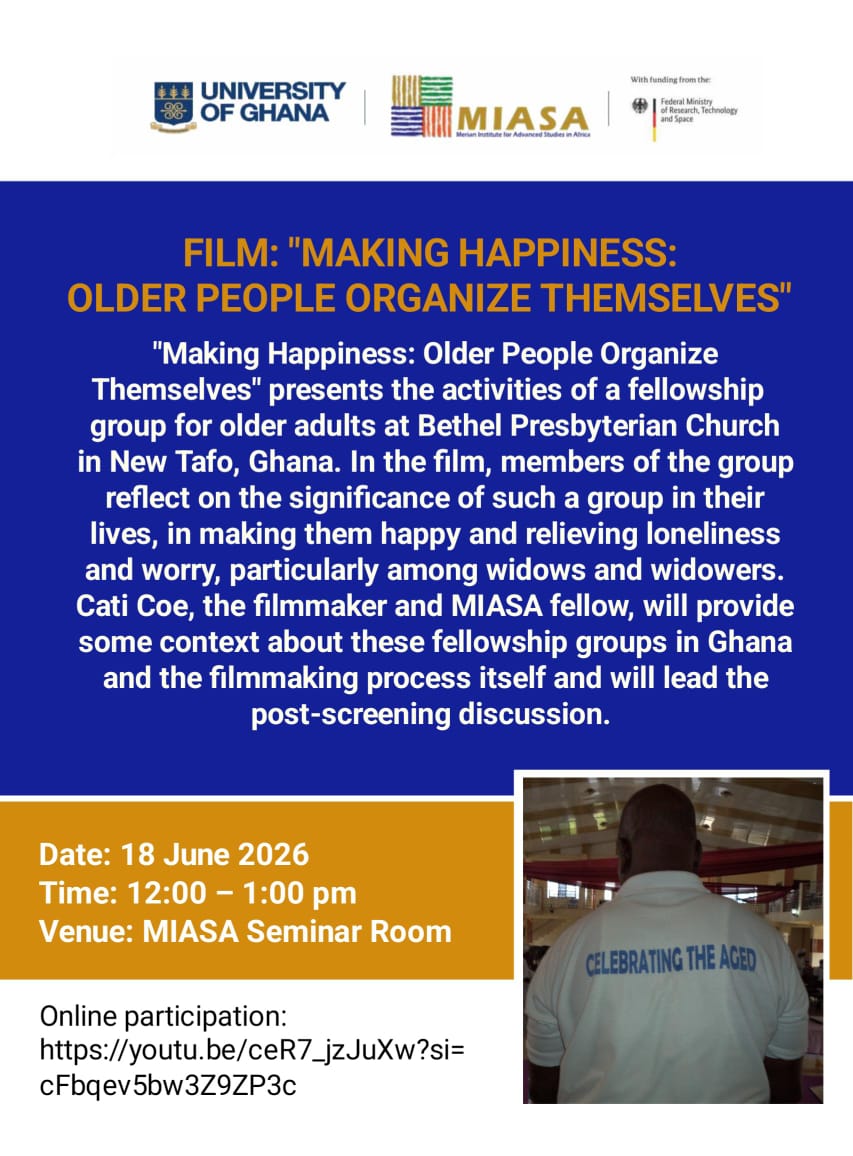
Film: “Making Happiness: Older People Organize Themselves”
FeaturedMIASA Seminar Room"Making Happiness: Older People Organize Themselves" presents the activities of a fellowship group for older adults at Bethel Presbyterian Church in New Tafo, Ghana. In the film, members of the group reflect on the significance of such a group in their lives, in making them happy and relieving loneliness and worry, particularly among widows and ... Read more
-
Dance Performance: Kor yε; Artist in Residence: Natasa Chanta-Martin
Department of Dance Studies, University of GhanaDescription: During her MIASA residency, Natasa explored what happens to Ghanaian dance and music cultures when the musical instruments are not there. How do moving bodies suffice as repositories of knowledge and of embodied music? Is our body enough for the sustainability of our intangible cultural heritage? The answer is explored through the medium of ... Read more
-
-
Public Roundtable: Beyond Representation: Strengthening Women’s Leadership and Transforming Academic Cultures in African Higher Education
For online participation: https://maxweberstiftung.zoom-x.de/j/62475717218 Women are increasingly getting represented in African higher education, including in academic leadership positions. While this marks important progress, the numbers remain far from being equitable. More importantly, the representations do not automatically translate into impact or influence. The challenge is not only increasing the number of women in leadership, but also ... Read more
-
Public Lecture: Rethinking Mining Governance from the Grassroots Up: Eastern Senegal Facing the Challenges of Extractivism and Security Threats; Speaker: M. Lamine Diallo
MIASA Seminar RoomAbstract: This paper offers a critical analysis of mining resource governance in eastern Senegal, viewed not solely through institutional frameworks but through the practices, forms of resistance, and local arrangements that shape daily life in mining regions—that is, a “bottom-up” approach to governance. This analysis takes place in a border region plagued by security threats ... Read more
-
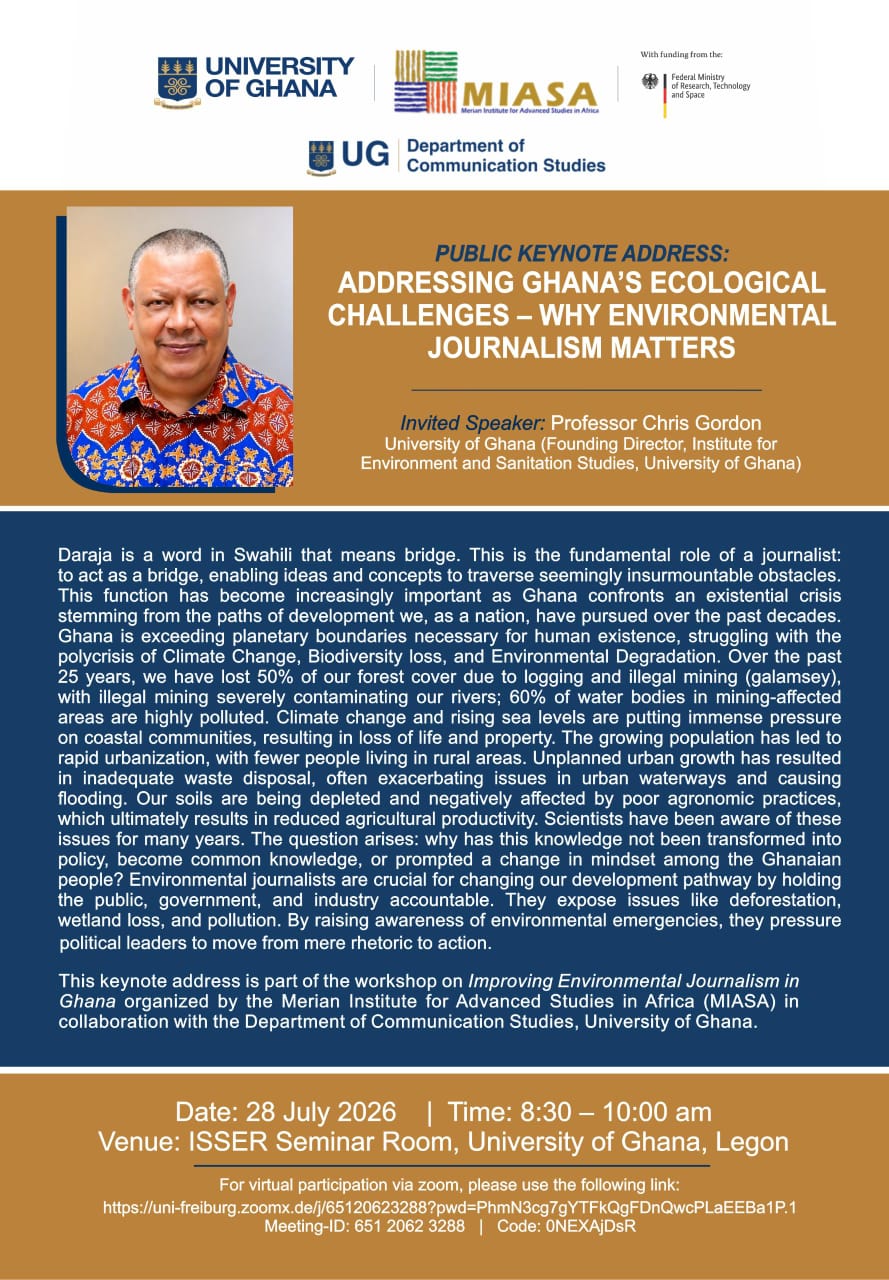
Public Keynote Lecture: Addressing Ghana’s Ecological Challenges – Why environmental journalism matters; Invited Speaker: Professor Chris Gordon, University of Ghana
ISSER Seminar Room, University of Ghana, LegonAbstract: Daraja is a word in Swahili that means bridge. This is the fundamental role of a journalist: to act as a bridge, enabling ideas and concepts to traverse seemingly insurmountable obstacles. This function has become increasingly important as Ghana confronts an existential crisis stemming from the paths of development we, as a nation, have ... Read more
-
-
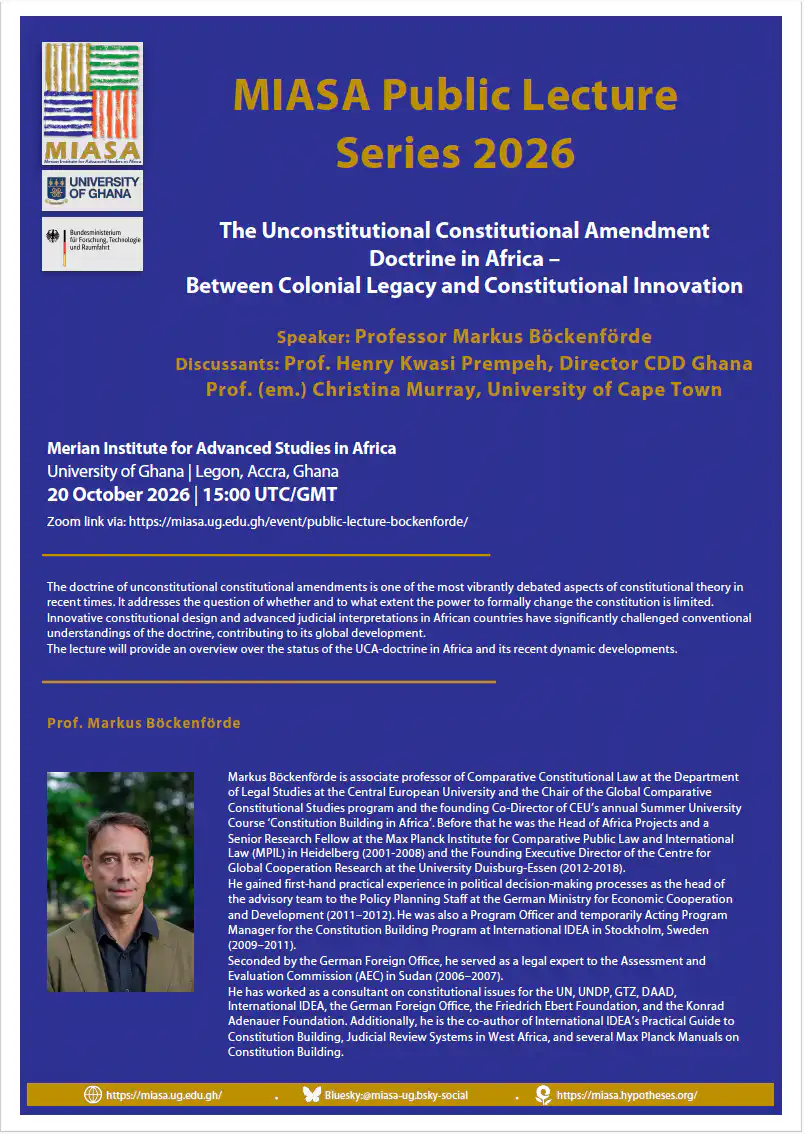
Public Lecture: The Unconstitutional Constitutional Amendment Doctrine in Africa – Between Colonial Legacy and Constitutional Innovation; Speaker: Prof. Markus Böckenförde
Discussants: Prof. Henry Kwasi Prempeh, Director CDD Ghana Prof. (em.) Christina Murray, University of Cape Town Abstract: The doctrine of unconstitutional constitutional amendments is one of the most vibrantly debated aspects of constitutional theory in recent times. It addresses the question of whether and to what extent the power to formally change the constitution is limited. Innovative ... Read more